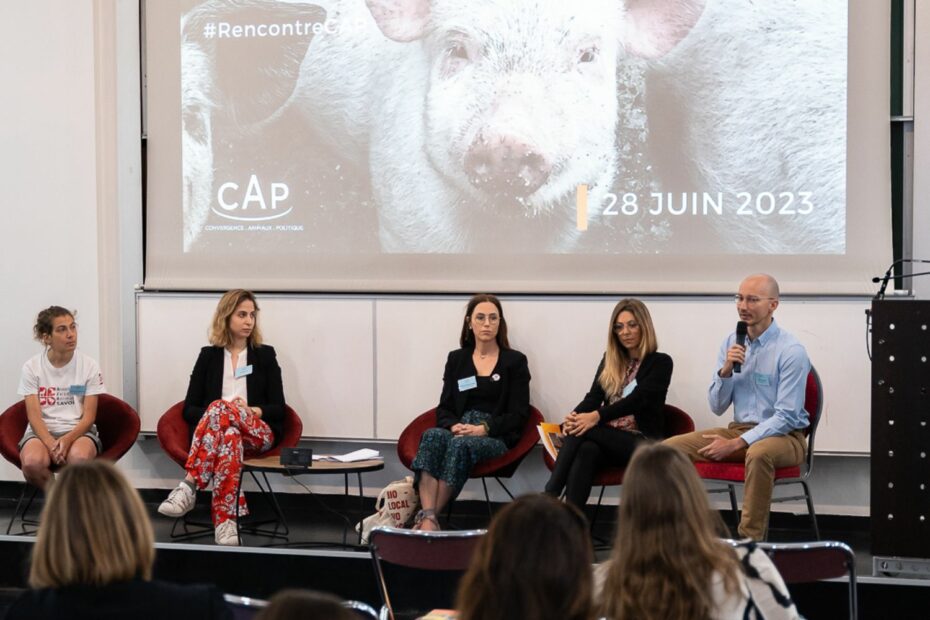
Wednesday, June 28, Convergence Animaux Politique gathered around forty MPs, candidates in the European elections, policy advisors, local elected officials, and NGOs in Paris to identify effective policy levers to improve farmed animal welfare and move away from factory farming in France.
Among the MPs present were Sylvain Carrière (LFI), Rodrigo Arenas (LFI), Sandrine Rousseau (EELV), Anne-Laurence Petel (REN), Senator Samantha Cazebonne (RDPI), and Senator Arnaud Bazin (LR), as well as local elected officials. Watch below the event summary video and the participants’ testimonials.
1) Improve the living conditions of farm animals



Summary of the intervention by Capucine Meyer from the organization Humane Society International (HSI) Europe.
Reducing the suffering of farmed animals is a major issue that the European Union (EU) has acknowledged by initiating a revision of its animal welfare legislation. France is one of the leading producers of meat and animal-based products in the EU; it therefore has a key role to play in driving the legislative changes desired by citizens. According to an official Eurobarometer survey, more than 9 out of 10 European citizens believe that the welfare of farmed animals is important, and 84% believe that they should be better protected than they currently are.
This is why the NGO Humane Society International (HSI) Europe calls on policymakers to:
- encourage positive initiatives aimed at ending unnecessary suffering inflicted on farmed animals;
- actively support the European Commission’s work in revising standards, such as the Farm to Fork Strategy and the Agricultural Orientation and Future Law (PLOAA), which can contribute to improving farmed animal welfare;
- redirect public budgets such as the Finance Bill (PLF) or the National Low-Carbon Strategy (SNBC) to provide greater support to systems that take animal welfare into account;
- include the protection of farmed animals in political party platforms for the 2024 European elections.
2) Informing consumers
Summary of the intervention by Nikita Bachelard from the Fondation Droit Animal, Éthique et Science (LFDA).
Consumers want to be informed as transparently as possible about the level of animal welfare and the farming methods used for the animals whose products they consume. According to a CSA survey (March 2023), more than one in two French people say they are willing to pay more for a product that displays animal welfare labelling (62% among those under 35).
Tools already exist, such as the Animal Welfare Label created in 2017 through a partnership between three animal protection organizations (LFDA, CIWF France, and OABA) and the Casino Group. The first species covered is chicken, with more than 3,000 farms already voluntarily audited.
To encourage a more ethical food supply, the Fondation Droit Animal, Éthique et Science (LFDA) calls for:
- the introduction of mandatory animal welfare and farming method labelling for all animal-based food products;
- government support for the Animal Welfare Label through the official involvement of the French National Research Institute for Agriculture, Food and Environment (INRAE).
3) Move away from factory farming
Summary of the intervention by Pauline di Nicolantonio, President of the Association Justice Animaux Savoie (AJAS).
Today, intensive farming is the norm in France: more than 80% of animals are raised in this type of system, described as “standard” or “conventional” farming. Behind this neutral term lies, in reality, a system involving significant animal suffering, but it also pollutes water and air, degrades soils, threatens biodiversity, poses a public health risk, and creates great distress among indebted farmers. It is therefore an ethical, ecological, and economic aberration that urgently needs to be ended.
Several courses of action were proposed by the Association Justice Animaux Savoie (AJAS):
- fundamentally rethink our production systems by introducing a moratorium on intensive farming, implementing a support plan to help farmers transition toward alternative forms of production, ending public subsidies granted to intensive farming, and immediately banning new intensive farming projects as well as the expansion of existing ones;
- set a deadline for a total ban on the worst practices, particularly a ban on cage ;
- improve transparency for consumers by preventing quality labels (Label Rouge, AOP, IGP, “farm”, regional appellations) from relying on intensive production systems.
4) Regulating the land transport of live animals
Summary of the intervention by Clémence Scialom-Ouard from the organization QUATRE PATTES.
The European Commission, driven by the European Parliament and in response to the expectations of European citizens, has decided to revise various EU legal texts on animal welfare, including the Transport Regulation (EC). This revision represents a unique opportunity to improve the lives of billions of farm animals transported for days, or even weeks, under poor conditions across European Union borders and to third countries (see the report Live animal transport: time to change the rules).
France must rise to the level of this European revision and take into account the ongoing transition toward a new farming model. Several key measures were presented by the NGO:
- introduce a maximum transport duration of 8 hours (4 hours for poultry and rabbits);
- ban the transport of unweaned and pregnant animals, long-distance transport of animals, sea transport of live animals, and the export of live animals to third countries;
- implement alternatives such as transporting meat and germinal products instead of live animals, and slaughtering animals at the nearest slaughterhouse;
- prohibit animal transport when temperatures are below 5°C or above 25°C, or when transport planning indicates that animal welfare regulations cannot be met;
- strengthen controls on live animal transport and ensure effective enforcement of penalties in case of violations.
5) Strengthening controls on the maritime transport of live animals
Summary of the intervention by Nathalie Soisson, President of the Association for the Protection of Animals through Law (APRAD)
Every year, millions of farm animals are transported by sea around the world. Investigations carried out by NGOs as well as various institutions (ANIT report, European Court of Auditors, EFSA, etc.) clearly highlight the multiple failures, inconsistencies, and unequal enforcement surrounding these transports, ultimately making them examples of poor practice.
These vessels should be priority targets for inspections, yet they are rarely checked. It is therefore essential to:
- significantly strengthen inspections of ships under Port State Control, identify deficiencies, and apply necessary detentions;
- require proper veterinary checks before loading and ensure the presence of veterinarians on board during the journey, or at least of animal handlers with veterinary experience;
- tighten the conditions for ship certification, require specific training for crews, and install onboard cameras;
- support these developments within the framework of the revision of EU animal welfare standards, as well as the modernization of EU rules on maritime safety and pollution;
- ultimately replace live animal transport with the transport of carcasses using refrigerated ships.
6) Support farmer transition
Summary of the intervention by Silvère Dumazel, President of the association TransiTerra.
Beyond causing significant harm to animals, the environment, and human health, some intensive livestock farms are neither profitable nor socially sustainable.
They require substantial debt for highly variable profitability: each year between 2018 and 2021, the 10% least profitable poultry farms recorded a negative operating result. Low income and indebtedness are sources of psychological distress among farmers and are among the factors contributing to the higher suicide mortality rate in this profession.
Furthermore, France has made climate commitments aimed at reducing greenhouse gas emissions: the target set for agriculture is a reduction of -46% in GHG emissions between 2015 and 2050. The National Low-Carbon Strategy (SNBC 2) sets a course of reducing livestock numbers, with targets of -30% for pigs and -20% for broiler chickens between 2020 and 2050.
For this reason, the association TransiTerra calls for the implementation of a support program for the transition of factory farms, including:
- a support program for young and new farmers taking over factory farming, to help convert them toward more sustainable production systems;
- compensation grants for agricultural conversion in the event of closure of intensive livestock buildings or transition toward plant-based production;
- a training program on agroecological transition, farm resilience, risk management, and farm transferability.
Such a program should be accompanied by the conditioning of public investment subsidies and the INAF guarantee fund, facilitating access to bank financing based on social and environmental sustainability criteria.
Fostering Dialogue and Cooperation Between MPs and NGOs
The CAP Meetings, and in particular this specific meeting, provided a space for dialogue and exchange of ideas between political decision-makers and experts on the issue of farm animal welfare. Political actors were thus able to benefit from the expertise of associations on the matter and take note of existing and future solutions regarding this issue.